Silicone vs Polyurethane Sealant Guide
Side-by-side engineering comparison of silicone, polyurethane, and hybrid MS polymers covering ASTM C920 ratings, UV durability, and movement class.
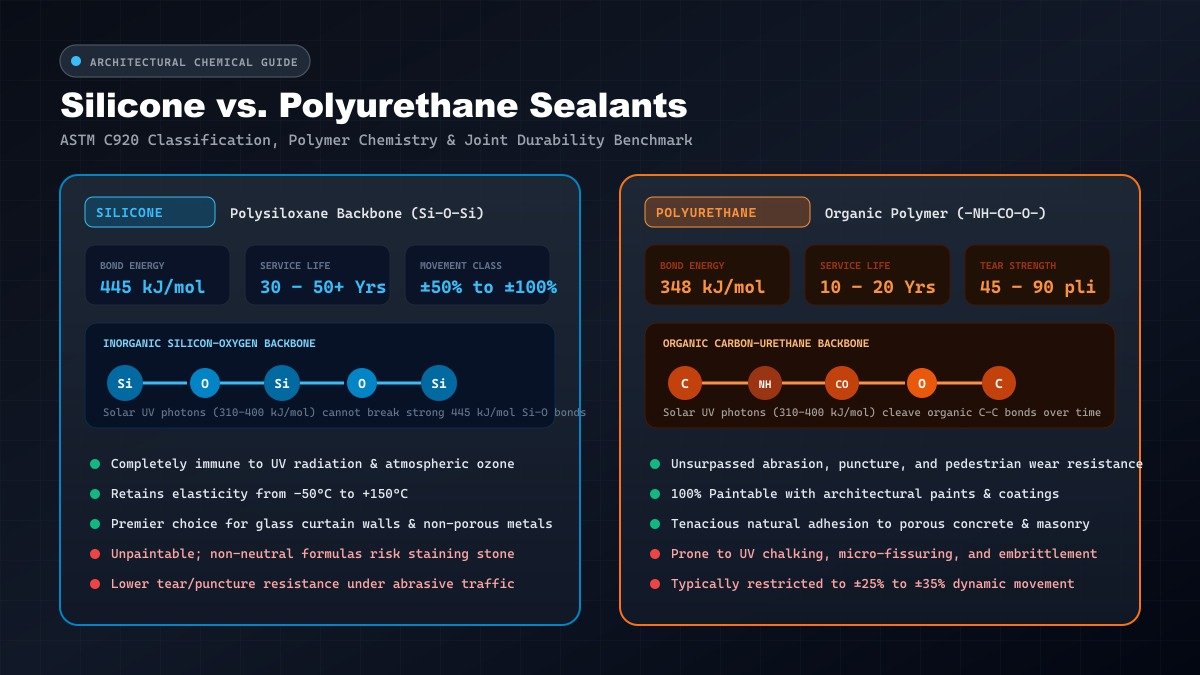
When specifying elastomeric sealants for high-performance building envelopes, civil infrastructure, or architectural glazing, selecting between Silicone and Polyurethane (PU) is the single most critical material decision an engineer or contractor will make.
While both chemistries qualify as high-performance elastomeric sealants under ASTM C920 (Standard Specification for Elastomeric Joint Sealants), they are fundamentally different polymers. Their differences stem not from marketing or additives, but from atomic bond physics. Choosing incorrectly can result in severe UV chalking, substrate staining, paint rejection, or premature adhesive bond release within just a few years of installation.
In this definitive engineering guide, we examine the molecular bond thermodynamics of both materials, present an exhaustive 14-parameter technical benchmark table, break down silicone and polyurethane sub-chemistries, introduce modern hybrid MS polymers (STPE), map trade-by-trade selection criteria, and answer critical specification FAQs.
1. Polymer Chemistry & Molecular Bond Thermodynamics
The performance differences between silicone and polyurethane originate at the atomic scale: the chemical bond dissociation energy of their macromolecular backbones.
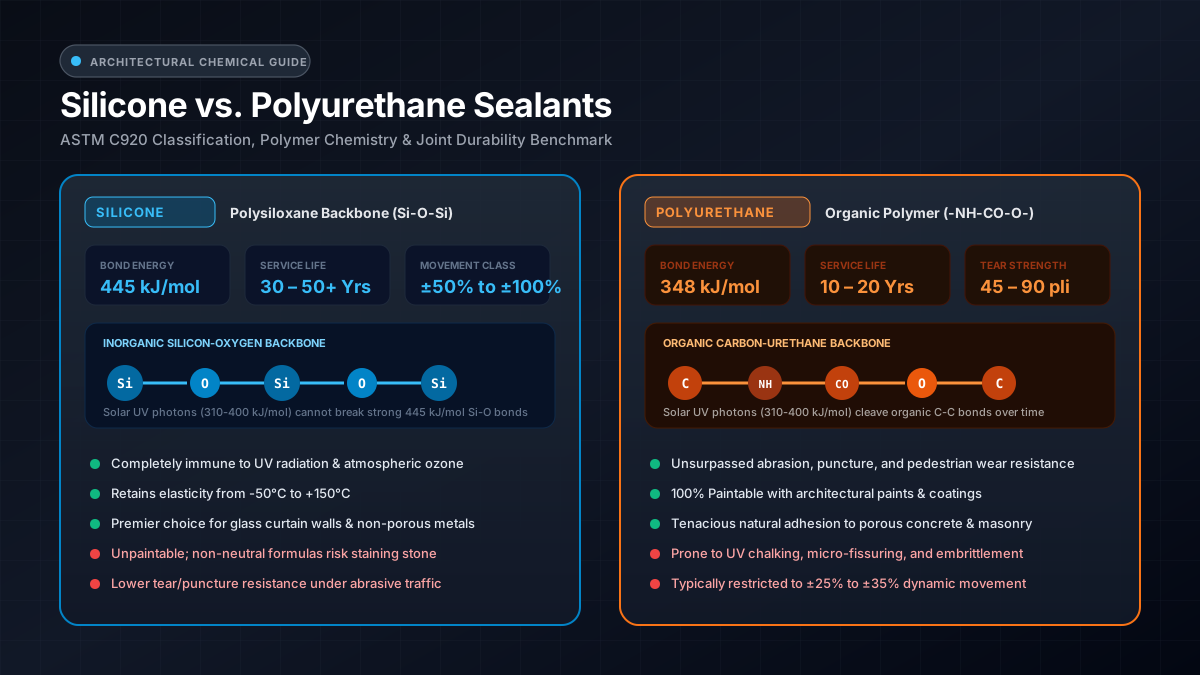
Figure 1: Molecular architecture comparison: Inorganic silicon-oxygen bond (445 kJ/mol) versus organic carbon-carbon and carbon-nitrogen urethane bonds (348 kJ/mol).
The Physics of Solar UV Degradation
Solar radiation reaching the earth’s surface contains high-energy ultraviolet photons (UV-A and UV-B) with wavelengths ranging between 290 nm and 400 nm. According to the Planck-Einstein relation:
E = (hc / λ)Photons in this solar UV range carry quantum energies between 300 kJ/mol and 413 kJ/mol.
- Polyurethane’s Organic Vulnerability (
348 kJ/mol): The backbone of polyurethane is built from organic carbon-carbon (C-C) and carbon-nitrogen (C-N) single bonds with dissociation energies of approximately348 kJ/moland305 kJ/mol. Because solar UV photons carry up to413 kJ/mol, they possess more than enough energy to cleave these organic polymer chains directly (photolytic chain scission). Over 5 to 10 years of direct solar exposure, this causes surface chalking, micro-fissuring, embrittlement, and loss of elastomeric movement capability. - Silicone’s Inorganic Immunity (
445 kJ/mol): By contrast, silicone possesses an inorganic polysiloxane backbone composed of alternating silicon and oxygen atoms (Si-O-Si). The silicon-oxygen chemical bond has an exceptional dissociation energy of445 kJ/mol. Because the maximum energy of terrestrial sunlight (413 kJ/mol) is lower than445 kJ/mol, solar UV light cannot chemically break the silicone backbone. As a result, silicone sealants remain flexible and unaffected by UV radiation, ozone, and acid rain for 30 to 50+ years.
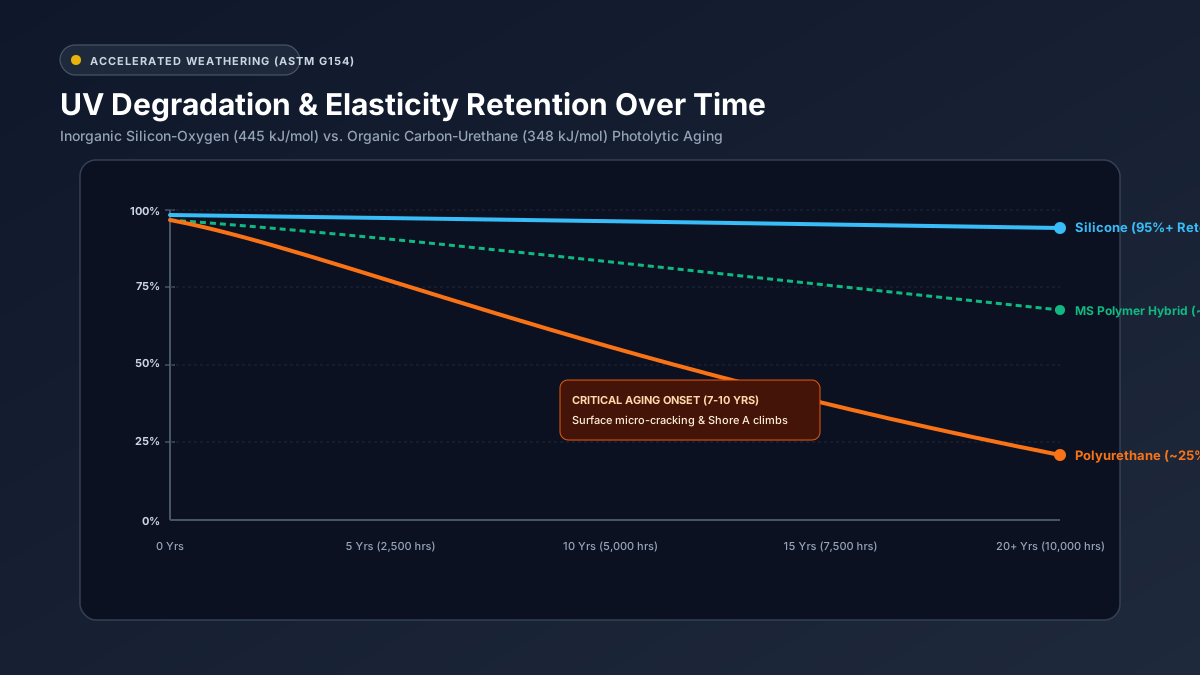
Figure 2: Accelerated weathering performance (ASTM G154): Silicone retains over 95% of original tensile elongation after 10,000 hours of QUV exposure, whereas polyurethane exhibits gradual surface photo-oxidation and hardening.
2. Exhaustive 14-Parameter Technical Benchmark Matrix
The following comprehensive engineering matrix benchmarks Silicone, Polyurethane, and modern Hybrid MS Polymer (STPE) sealants across primary ASTM laboratory test standards:
| Technical Property | Silicone (ASTM C920) | Polyurethane (ASTM C920) | Hybrid MS Polymer / STPE |
|---|---|---|---|
| Polymer Backbone | Inorganic (Si-O-Si) | Organic (C-C, Urethane) | Polyether with Silyl Terminals |
| Movement Class (ASTM C719) | ±50% to ±100% (Class 50/100) | ±25% to ±35% (Class 25/35) | ±25% to ±50% (Class 25/50) |
| Service Life Expectancy | 30 to 50+ Years | 10 to 20 Years | 20 to 30 Years |
| Direct Paintability | ❌ Unpaintable (Repels paint) | ✓ 100% Paintable | ✓ 100% Paintable |
| Tear & Abrasion Resistance | Moderate (15 to 30 pli) | Superior (45 to 90 pli) | High (35 to 60 pli) |
| UV / Weathering Stability | Immune (Zero chalking) | Moderate (Chalks over 10 yrs) | Very High (Minimal chalking) |
| Operating Temperature | -50°C to +150°C (-58°F to +302°F) | -40°C to +80°C (-40°F to +176°F) | -40°C to +90°C (-40°F to +194°F) |
| Adhesion to Glass / Glazing | Tenacious (Primerless) | Poor without Primer | Good (Primer recommended) |
| Adhesion to Porous Concrete | Requires Primer (Non-staining) | Tenacious (Primerless) | Tenacious (Primerless) |
| Stone Staining Risk (ASTM C1248) | High (Plasticizer fluid migration) | Zero to Low | Zero (Non-staining) |
| VOC Content & Odor | Low VOC; Acetic or mild oxime | Contains Isocyanates & Solvents | Zero VOC, Zero Isocyanates, Odorless |
| Moisture Blistering Risk | None (Cannot bubble) | High (CO₂ outgassing with damp concrete) | None (Bonds to damp concrete) |
| Submersion Water Immersion | Good (With specialized primer) | Excellent (Waterproofing standard) | Good |
| Relative Cost per Liter | Moderate to Premium ($$$) | Economical to Moderate ($$) | Moderate to Premium ($$$) |
3. Sub-Chemistries: Acetoxy vs. Neutral Silicone
Within the silicone category, applicators must distinguish between two radically different curing mechanisms:
A. Acetoxy-Cure Silicones (The “Vinegar” Silicones)
- Mechanism: Moisture in the air triggers hydrolysis, releasing acetic acid vapor during cure (generating a pungent vinegar odor).
- Ideal Uses: Glazed ceramic tile, glass-to-glass sanitary seams, fiberglass, vitrified porcelain, and aquarium construction.
- Strict Prohibitions: Never use acetoxy silicone on concrete, brick, mortar, marble, copper, lead, or mild steel. The released acetic acid reacts chemically with the alkaline lime in concrete and mortar, creating a powdery layer of calcium acetate that causes the sealant to delaminate completely within months. On metals, it accelerates rapid electrolytic corrosion.
B. Neutral-Cure Silicones (Alkoxy & Oxime)
- Mechanism: Releases alcohol (alkoxy) or methyl ethyl ketoxime (oxime) during cure.
- Ideal Uses: Architectural facade movement joints, metal curtain walls, structural glazing (ASTM C1184), anodized aluminum window frames, precast concrete, and marble (with specialized non-staining formulas conforming to ASTM C1248).
- Advantages: Non-corrosive, odorless or very mild odor, compatible with almost all construction substrates, and achieves high movement classes (ASTM C920 Class 50 and Class 100/50).
4. Polyurethane Formulations: 1-Part vs. 2-Part Systems
Polyurethane sealants are formulated into two distinct delivery formats:
1-Component (1K) Moisture-Curing Polyurethanes
- Mechanism: Ready-to-dispense paste packaged in cartridges or sausages. It reacts with ambient moisture vapor in the atmosphere to trigger polymerization.
- Cure Dynamics: Skins over in 2 to 4 hours; cures inward at a rate of approximately
2 mm to 3 mmper 24 hours at 23°C (73°F) and 50% relative humidity. - Cold-Weather Limitation: In dry winter weather (low humidity and sub-freezing temperatures), 1K polyurethanes cure extremely slowly, sometimes taking weeks to achieve full mechanical cure.
- Moisture Bubbling Hazard: If applied over damp or green concrete on a hot morning, the unreacted isocyanates (
R-NCO) react with water (H_2O) to form carbon dioxide (CO_2) gas:
R-NCO + H_2O \rightarrow R-NH_2 + CO_2 \uparrow$$
  This causes internal foam bubbles and blisters that ruin the seal.

### 2-Component (2K) Chemically Curing Polyurethanes
- **Mechanism:** Packaged in 1.5 to 3-gallon bulk pails consisting of a base resin and an activator chemical curing agent, mixed on-site with an electric drill paddle.
- **Cure Dynamics:** Cures via internal chemical cross-linking independently of atmospheric moisture or joint depth. It cures completely through a `25 mm` joint in 6 to 12 hours.
- **Ideal Uses:** Fast-turnaround commercial warehouse floors, airport apron joints, vehicular parking garages, and cold-weather construction where fast return-to-service is mandatory.

---

## 5. The Evolution: Hybrid MS Polymer / STPE Sealants

In recent years, materials scientists developed **Silyl-Modified Polymers (SMP)**—also known as **MS Polymers** or **Silane-Terminated Polyethers (STPE)**.

Hybrid sealants combine the best attributes of both silicone and polyurethane into a single polymer matrix:
1. **Silicone's Strengths:** Superior UV resistance, extreme weather durability, zero isocyanates, zero VOCs, and primerless adhesion to metals.
2. **Polyurethane's Strengths:** **100% paintable** with water- and oil-based architectural coatings, high mechanical tear strength, and tenaciously bonds to concrete and brick.
3. **Solves the Moisture Bubbling Problem:** Unlike polyurethanes, hybrid MS polymers do not contain free isocyanates. They will not form `CO_2` gas bubbles when applied to damp substrates.

---

## 6. Specification Decision Flowchart & Trade Matrix

To determine the ideal sealant for your specific architectural or industrial application, follow this specification flowchart:

<figure class="my-8 rounded-2xl overflow-hidden border border-slate-200 shadow-sm bg-slate-900/5">
  <img
    src="/images/blog/chemistry-selection-flowchart.svg"
    alt="Architectural decision flowchart guiding material selection between Silicone, Polyurethane, and Hybrid MS Polymer"
    class="w-full h-auto aspect-[16/9] object-cover"
    loading="lazy"
  />
  <figcaption class="p-3 text-xs text-center text-slate-500 bg-slate-50 border-t border-slate-100">
    Figure 3: Architectural material selection flowchart based on substrate porosity, environmental UV exposure, paintability requirements, and joint movement class.
  </figcaption>
</figure>

### Application Guide by Construction Trade

- **Glazing & Curtain Wall Contractors:** Specify **Neutral-Cure Silicone (Class 50)** (e.g., Dow Dowsil 795, Tremco Spectrem 2). Non-porous glass-to-aluminum adhesion and multi-decade UV immunity are non-negotiable.
- **Concrete & Facade Restoration Specialists:** Specify **Low-Modulus Silicone** (e.g., Dow Dowsil 790) for high-movement precast concrete panels (±100% movement capability prevents substrate spalling). Alternatively, specify **Hybrid MS Polymer** (e.g., Tremco Dymonic FC) if the facade is scheduled for exterior acrylic painting.
- **Civil & Industrial Flooring Contractors:** Specify **Traffic-Grade Polyurethane** (e.g., Sika SikaFlex 1a, MasterSeal NP1) or semi-rigid polyurea. Polyurethane's superior tear strength (45–90 pli) withstands heavy forklift wheels, luggage cart traffic, and snowplow blades.
- **Tile & Sanitary Trades:** Specify **Sanitary Silicone with Fungicide** (e.g., Dow Dowsil Sanitary, GE Silicone II Bath). Provides 100% waterproof reliability and biocides to prevent black mold growth in high-humidity shower enclosures.
- **Residential Window & Door Installers:** Specify **Hybrid MS Polymer or Polyurethane**. Allows painters to coat the exterior perimeter bead flush with architectural trim without paint beading or wrinkling.

---

## 7. Frequently Asked Questions (FAQ)

### Can I paint over silicone sealant if I use an oil-based primer?
No. Standard architectural sealants have an exceptionally low surface energy (`≈ 24 mN/m`). Standard oil-based, latex, or acrylic paints cannot wet the surface; the paint film will bead up into droplets, crack, and peel away completely within weeks. If a movement joint must be painted, you must specify a **Polyurethane** or **Hybrid MS Polymer** sealant.

### Why does polyurethane caulk turn yellow or chalk after a few years?
Polyurethanes contain aromatic isocyanate compounds (such as MDI or TDI) in their polymer chain. When struck by solar UV radiation, these aromatic rings undergo photo-chemical rearrangement into quinoid chromophore structures, causing noticeable yellowing or browning. Continued UV exposure cleaves the polymer chains, turning the outer skin into a friable, chalky dust.

### What is fluid migration staining on natural stone?
Standard construction silicones contain low-molecular-weight unreacted silicone fluids and plasticizers. When applied to porous stone (such as Carrara marble, granite, or porous limestone), these fluids leach out of the sealant bead into the stone's capillary pores. This creates an unsightly dark, greasy halo around the joint that cannot be cleaned or pressure-washed away. For natural stone, always specify a certified **Non-Staining Silicone tested to ASTM C1248**.

### Which is easier to tool: silicone or polyurethane?
Polyurethane is generally stickier and more viscous than silicone, requiring firm spatula pressure and proper tooling techniques to prevent stringing. Silicone tools with a smoother, butter-like consistency, but requires careful masking because any smeared residue will leave an unpaintable film on adjacent surfaces.

### Can I apply new silicone directly over old polyurethane sealant?
No. While silicone will bond to clean cured silicone, it will not bond reliably to old, weathered polyurethane residue. Old sealant must be completely cut out with a oscillating blade or razor knife, the substrate flanks mechanically wire-brushed or ground back to virgin concrete or bare metal, wiped clean with solvent, and fitted with a new backer rod before applying new sealant.

---

## Interactive Sizing & Material Calculators

Plan your sealant procurement with precision and verify ASTM compliance:

- [**Full Joint Volume & Cartridge Calculator**](/#calculator) — Estimate yields for tubes, sausages, and bulk pails.
- [**The 2:1 Joint Design Ratio Guide**](/blog/understanding-2-to-1-joint-design-ratio/) — Why depth controls internal cohesive strain.
- [**Backer Rod Sizing & Selection**](/blog/preventing-three-sided-adhesion-with-backer-rod/) — Prevent three-sided adhesion and ensure proper hourglass tooling.